 (Image source: Gemini)
 You probably felt it before you saw it on a slide deck. The air in the office, or the vibe on the Slack channel, has shifted. It is 2026, and we are well past the era of ping-pong tables and free kombucha being enough to keep people happy. Those were just surface-level distractions from the real work of building a culture. What we are seeing now is a quiet revolution. It is not always making front-page news, but it is fundamentally rewriting the deal between you and your employer. This shift is moving away from a transactional model, where you trade time for money, toward a relational model based on shared values and mutual respect.
Have you noticed how much more you care about why a decision was made rather than just what the decision was? That is the invisible shift at play. Employee expectations have moved far beyond the paycheck. They are now rooted in autonomy, transparency, and a demand for work that actually fits into a human life.
Radical Transparency and Open-Book Management
There was a time when the inner workings of a company were treated like state secrets. Executives would disappear into a boardroom and emerge with a set of directives that felt like they were handed down from a mountain top. Those days are over.
Today, you likely expect a level of "open-book" management that would have terrified a CEO ten years ago. Employees want to see the math. They want to understand the revenue goals, the challenges, and the messy logic behind why certain projects get the green light while others die.
This transparency is not just about being nice. It is a survival approach for companies. When you understand the "why," you are more likely to stay through the "how." It builds a level of trust that no "team-building" retreat could ever replicate. We are moving away from top-down commands and toward a collaborative narrative where everyone feels like they are reading the same book.
Sustainable Productivity Over Always-On Hustle
Remember the "hustle culture" era? The days when answering an email at 11:00 PM was a badge of honor? That trend has officially soured. In 2026, performative busyness is being replaced by a focus on sustainable output.
Many organizations are now implementing "Right to Disconnect" policies as a standard cultural norm. This is not just a suggestion. It is a boundary that protects your mental energy. Companies are finally realizing that a burnt-out employee is an expensive liability, not a hero.
We are also seeing the rise of "Quiet Cracking." This is a slow emotional withdrawal that happens when the pressure becomes too much. Reports show that nearly one in five employees is in a state of quiet cracking because of economic stress and the rapid integration of new technology. To fight this, smart leaders are redefining what "availability" looks like. They are prioritizing deep work over constant pings and valuing the quality of your work over the quantity of your hours.
Human-Centric Professional Development
Professional development used to mean sitting through a dry PowerPoint presentation about a new software update. Now, it is becoming much more personal. You likely want growth that treats you like a whole human being, not just a cog in a machine.
The demand for "soft skills" training, like emotional intelligence and conflict resolution, is skyrocketing. Organizations are also moving toward skills-based hiring. Degrees are no longer the only way to prove you can do a job. Like, IBM has opened about 50 percent of its job postings to candidates without four-year degrees, focusing instead on what people can actually do.³
This human-centric approach also means integrating mental health directly into your career path. It is no longer a separate "perk" you find in an HR handbook. It is a part of the daily conversation. Whether it is "microshifting" - working in short, intense blocks that match your natural energy levels - or personalized coaching, the goal is to help you grow without breaking you.⁶
The Office as a Purposeful Hub
The "return to office" debate has mostly settled into a new reality. As of 2026, over half of remote-capable workers are in hybrid roles.¹⁰ But the office itself has changed its identity. It is no longer the default place where you go to sit in a cubicle and do work you could have done at your kitchen table.
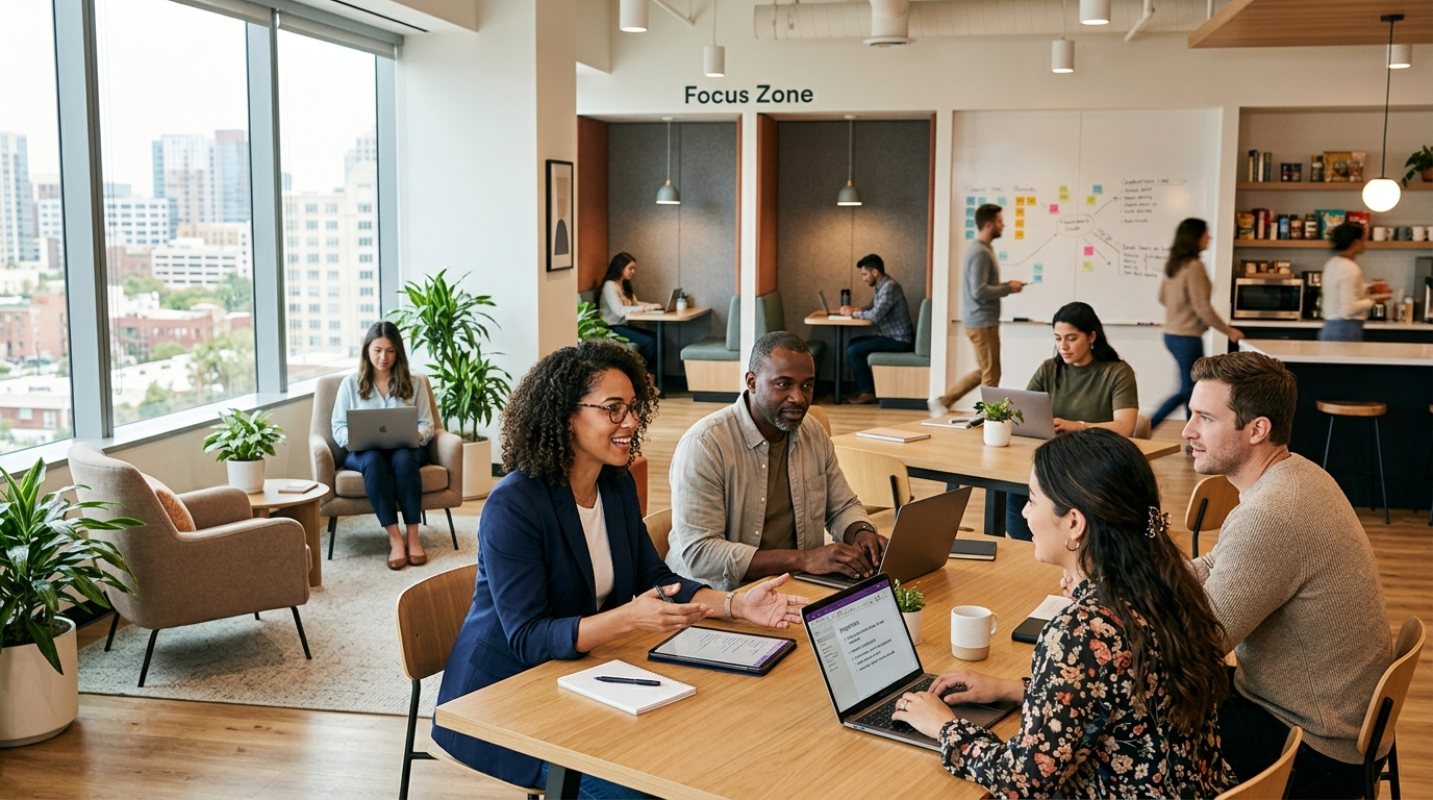
If a company wants you to commute, they have to "earn" it. The office is now being redesigned as a purposeful hub for intentional gathering. Think of it as a collaboration studio rather than a factory for emails.
- Participation over Presence: The focus is on what you do when you are there, not how many hours your chair is occupied.
- Curated Experiences: Offices are being used for high-impact meetings, creative brainstorming, and social bonding that builds the "human glue" of a team.
- Quiet Hiring: Organizations are increasingly looking inward to fill gaps, moving talented people into new roles rather than always looking for external hires.¹
This shift means the physical workspace is becoming more flexible. You might see more open lounges for talking and more soundproof pods for deep focus. The goal is to make the office a tool you use, not a cage you are kept in.